


22 May How Helical Piers Are Installed: A Step-by-Step Process
Discovering that your property suffers from settling, uplift, or slope instability can be stressful. Your building needs a solid base to remain safe and functional. When traditional concrete solutions fall short, deep foundation systems step in to carry the load. You might have heard of these systems referred to as helical piers or helical piles.
Understanding the installation process can alleviate the anxiety associated with major property maintenance. Unlike massive excavation projects that tear up your entire landscape, modern deep foundation solutions are surprisingly clean and efficient. The equipment is compact, noise is kept to a minimum, and the results are engineered to last a lifetime.
What Are Helical Piers and Helical Piles?
Before diving into the process, it is helpful to understand the hardware. Helical piers are large, screw-like steel shafts equipped with helical bearing plates. These plates allow the steel pile to be driven deep into the ground, twisting through unstable surface layers until they reach dense, load-bearing soil or bedrock.
Because they act like massive screws, these piles create a permanent, anchor-like grip within the earth. They transfer the weight of the structure away from the weak, shifting soils near the surface and down to stable layers deep below.
The Step-by-Step Installation Process
A successful installation relies on precise engineering and careful execution. Here is how professional teams ensure your building gets the support it needs.
Step 1: Thorough Site Evaluation and Engineering
The first step involves a comprehensive evaluation. Structural engineers assess the site to understand the nature of the settlement and review the structural layout. In regions like Utah, technicians account for high water tables and freeze-thaw cycles to develop an engineered plan tailored specifically to your load requirements.
Step 2: Securing Approvals and Site Preparation
A reputable contractor handles all necessary permitting to keep your project compliant with local building codes. Site preparation is minimal; crews simply clear the immediate area around the installation points and expose the base of the foundation footer if working on an existing building.
Step 3: Driving the Helical Piles
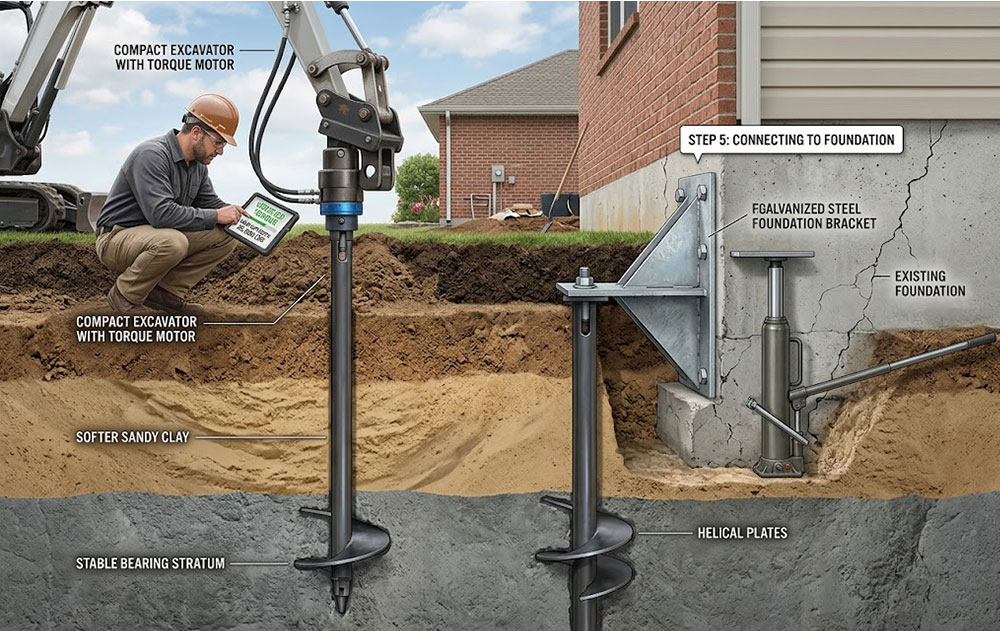
Crews use specialized hydraulic torque motors attached to compact excavators. The helical plates pull the shaft downward, minimizing soil displacement. Steel extension shafts are added until the pile reaches the target depth specified in the engineering plan.
Step 4: Load Testing and Torque Verification
As the motor drives the shaft, technicians monitor the rotational torque. The amount of resistance correlates directly to the load-bearing capacity. This real-time verification guarantees that every pile can support the designated weight of the structure before the job is considered done.
Step 5: Connecting to the Foundation
For existing foundation repair, a heavy-duty steel bracket is secured to the foundation footer. The pile is cut to height and attached to the bracket. Using hydraulic jacks, the crew transfers the building’s weight onto the piers, often allowing them to lift the structure back toward its original, level elevation.
Step 6: Documentation and Warranty Delivery
Once backfilled, you receive full reporting on the installation, including verified torque readings, depth measurements, and load test results. This is backed by a comprehensive warranty for long-term peace of mind.
Why This Method Outperforms Traditional Approaches
- Minimal Site Disruption: Very small footprint compared to massive concrete excavations.
- Immediate Load-Bearing: No waiting for concrete to cure; piles can bear weight immediately.
- Adaptability: Equipment can access tight residential property lines or confined industrial spaces.
Frequently Asked Questions
- How long does installation take?
- Many residential projects are completed in just a few days due to the lack of curing time.
- Can installation happen during the winter?
- Yes. Since no concrete is poured, installation can proceed year-round, even in freezing temperatures.
- Are these for new construction too?
- Absolutely. Installing deep foundations before pouring a new slab prevents future settlement issues entirely.
Secure Your Property with Expert Foundation Support
If you are noticing wall cracks, uneven floors, or sticking doors, it is time for a professional evaluation. Don’t settle for a temporary patch when you can have a permanent, engineered solution.
Contact Intermountain Helical Piers today to schedule your free, no-obligation site evaluation and take the first step toward a secure foundation.
No Comments