


08 May The Engineering Behind Helical Piers: How They Work
Every safe, durable structure relies on a solid foundation. However, soil conditions do not always cooperate with standard building practices. When the ground beneath a building shifts, settles, or fails to provide adequate support, structural integrity is immediately compromised. Addressing these deep-seated issues requires a specialized approach that goes far beyond simply pouring more concrete.
For decades, structural engineers have relied on advanced deep foundation systems to bypass weak surface soils and anchor structures firmly into stable, load-bearing strata. Among the most effective and fascinating of these systems is the helical pier. These devices act like massive screws, driving deep into the earth to stabilize commercial buildings, industrial facilities, and residential homes.
What Are Helical Piers?
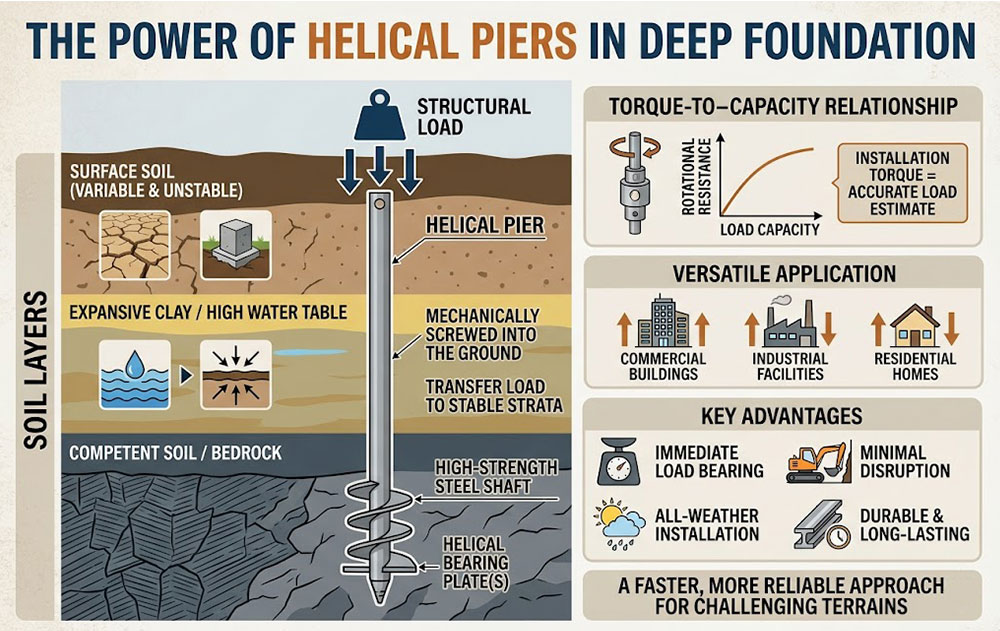
Helical piers, frequently referred to as helical piles or screw piles, are deep foundation underpinning elements manufactured from high-strength steel. They consist of a central steel shaft equipped with one or more helix-shaped bearing plates welded to the exterior.
These plates allow the pier to be mechanically screwed into the soil with specialized hydraulic equipment. Installers continue adding extension shafts until the helical plates reach a depth where the soil density is strong enough to support the required load of the structure above.
The Core Engineering Principles at Play
The success of helical piers in foundation repair relies on several fundamental engineering principles:
The Torque-to-Capacity Relationship
One of the most reliable aspects of helical pile engineering is the direct correlation between installation torque and load-bearing capacity. As the hydraulic motor drives the pier, it measures the rotational resistance. Engineers use mathematical formulas to convert this torque measurement into an accurate estimate of the pier’s ultimate holding capacity.
Load Transfer Mechanisms
Helical piles utilize end-bearing load transfer. The weight of the structure is transferred down the central steel shaft directly to the helical plates, which distribute the force across a wide area of deep, competent soil or bedrock.
Tension and Compression Support
While foundations primarily support downward weight (compression), helical plates also act as anchors to resist upward forces (tension or uplift) caused by high winds or expansive clay soils.
Why Soil Mechanics Matter
The effectiveness of any deep foundation system depends heavily on local geology. In regions like Utah, terrain challenges include high water tables, variable soils, and freeze-thaw cycles. Standard concrete footings often fail here because they are vulnerable to surface soil expansion. Engineered helical piles bypass these zones, resting on earth that remains stable year-round.
The Engineered Installation Process
- Evaluation and Engineering: Experts conduct a thorough site assessment and review soil reports to develop a customized plan.
- Approvals and Installation: Specialized hydraulic machinery rotates the piers into the ground. Load testing is verified in real-time to guarantee capacity.
- Documentation and Warranty: Owners receive full reporting and test results, proving the work was executed to exact engineered specifications.
Advantages Over Traditional Methods
- Immediate Load Bearing: Unlike concrete, steel piers can bear weight immediately after installation.
- Minimal Disruption: Compact equipment is ideal for tight spaces and generates minimal vibration.
- All-Weather Installation: Piles can be installed in freezing temperatures or high water tables without delay.
Frequently Asked Questions
- Are helical piers and helical piles the same thing?
- Yes, the terms are used interchangeably to refer to the same system of shafts and bearing plates.
- How long do helical piers last?
- When manufactured with galvanized steel, they are designed to last a lifetime, resisting oxidation even in damp or acidic soils.
- Can they lift a sunken house?
- In many cases, yes. Using specialized brackets and hydraulic jacks, the structure can be elevated back toward its original position before being secured.
Secure Your Foundation With Expert Engineering
At Intermountain Helical Piers, we specialize in underpinning and stabilization solutions tailored to challenging terrains. Every project is backed by structural calculations and precise soil reports.
If you are experiencing settlement or require reliable deep foundations, our team is ready to help. Contact us today to schedule a no-cost site evaluation and ensure your property rests on a foundation built to last.
No Comments